
As part of Numun’s recent Seed, Grow and Sustain 3.0 grant open call in August 2026, we engaged our very first cohort of 10 interns to undertake the first level eligibility screening of applications. They played a key role in this first phase of our participatory decision making process. Here, in their own words, some of the interns share their reflections on their experiences and takeaways. Read all posts by the SGS 3.0 interns here. Read about the overall SGS 3.0 desicion making process here.
Anaiz Zamora Márquez
What does it mean to accompany others from a place of care and of philanthropy? What kinds of decisions are taken when activism is in crisis? How should the redistribution of resources be approached? And how do we keep walking the path towards the sustainability of movements and the search for resources?
I have spent almost sixteen years of my life (nearly half of it) dedicating myself full-time to activism, recognising that working to build other possible worlds is exactly that —a work— and that it therefore needs remuneration that allows for a dignified life and a dignified rage. Along that road I have learned to hold conversations about the importance of counting on resources: not only sufficient ones, but disruptive ones. Resources that allow us to think about them in another way and from another place.
On that path, I have been part of several spaces, from grassroots movements and collectives to organisations, institutions and journalism, and, most recently, from the funding side. Numun Fund allowed me to join its first “intern cohort” and to take part (for a few months) in its decision-making process.
The invitation was to learn and to be part of the collective decision-making process for its second open call for proposals. To do so, it was necessary not only to immerse myself in the reflections built jointly on what feminist infrastructures and technologies mean, but also in what it involves being careful in the verification of data, the understanding of particular contexts, and the grasp of the needs of those submitting a proposal.
During the course of the work, I came to understand the human side of philanthropy, for it is real people who carry out the whole process of reflection, engagement and verification of information — an accompaniment that perhaps takes place through screens, but which carries deep reflections and raises questions all the time. Questions that serve to rethink criteria, definitions or concepts, and to imagine future calls and future responses.
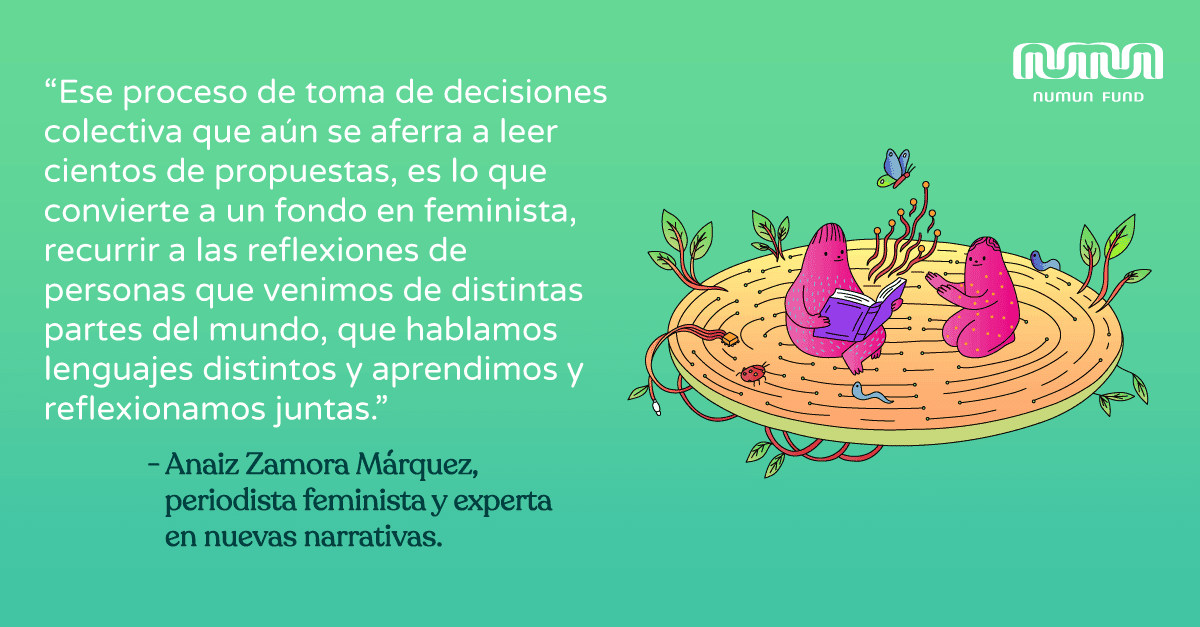
It is this participatory decision-making process, which still holds fast to reading hundreds of proposals, that makes a fund feminist: drawing on the reflections of people who come from different parts of the world, who speak different languages, and who learned and reflected together.
There are analyses that will keep appearing along this road that I still insist on travelling. I trust that the funds that stake their bets on supporting feminist endeavours will keep existing, learning and resisting. For me, that was what the process was: a way of continuing to cultivate amongst those of us who, from different fronts, are determined to build and walk differently.
Anaiz Zamora Márquez, feminist journalist and expert on new narratives.
Numun fund y su apuesta feminista
¿Qué significa acompañar desde el cuidado y desde la filantropía? ¿Qué tipos de decisiones se toman cuando el activismo está en crisis? ¿Cómo se piensa la redistribución de los recursos? ¿Cómo hay que seguir caminando en la búsqueda de la sostenibilidad de los movimientos y en la búsqueda de recursos?
Llevo casi 16 años de mi vida (casi la mitad) dedicándome de tiempo completo a los activismos. Reconociendo que trabajar en la construcción de otros mundos posibles es eso: un trabajo y que por lo tanto necesita una remuneración que permita la vida digna y la digna rabia. En ese camino he aprendido a sostener conversaciones sobre la importancia de contar con recursos, no solo suficientes, si no disruptivos. Es decir, recursos que nos permitan pensarlos desde otra manera y desde otro lugar.
En ese camino, he formado parte de varios espacios, desde movimientos de base, colectivos, organizaciones, instituciones, periodismo y más recientemente, del lado del financiamiento. Numun Fund me permitió ser parte de su primer “InternCohort” y ser parte (por algunos meses) de su proceso de toma de decisiones.
El llamado fue a aprender y a ser parte del proceso colectivo de toma de decisiones de su segunda convocatoria pública. Para hacerlo, no solo fue necesario que me empapara de las reflexiones construidas de manera conjunta sobre lo que significan las infraestructuras y las tecnologías feministas, si no también, de lo que implica ser cuidadosa en la verificación de datos, la comprensión de los contextos particulares, y el entendimiento de las necesidades de quienes presentan una propuesta.
Durante desarrollo del trabajo comprendí la parte humana de la filantropía, pues somos personas reales, quienes hicimos todo el proceso de reflexión, acercamiento y verificación de información, un acompañamiento que tal vez se da por las pantallas, pero que traspasa reflexiones profundas y todo el tiempo se plantea preguntas. Cuestionamiento que sirven para repensar los criterios, las definiciones o los conceptos, para imaginar futuras convocatorias y futuras respuestas.
Ese proceso de toma de decisiones colectiva que aún se aferra a leer cientos de propuestas, es lo que convierte a un fondo en feminista, recurrir a las reflexiones de personas que venimos de distintas partes del mundo, que hablamos lenguajes distintos y aprendimos y reflexionamos juntas.
Hay análisis que seguirán apareciendo en este camino que aún insisto en recorrer. Confío en que los fondos que apuestan por apoyar las apuestas feministas sigan existiendo, aprendiendo y resistiendo, para mí eso fue el proceso, una manera de seguir cultivando entre quienes, desde diferentes frentes, nos empeñamos en construir y andar distinto.
Anaiz Zamora Márquez, periodista feminista y experta en nuevas narrativas.