
As part of Numun’s recent Seed, Grow and Sustain 3.0 grant open call in August 2026, we engaged our very first cohort of 10 interns to undertake the first level eligibility screening of applications. They played a key role in this first phase of our participatory decision making process. Here, in their own words, some of the interns share their reflections on their experiences and takeaways. Read all posts by the SGS 3.0 interns here. Read about the overall SGS 3.0 desicion making process here.
When our intern cohort was introduced to Numun’s grantmaking and screening platform named “Mycelia,” the word instantly resonated with me. It made me realize just how deeply the underground world of fungi mirrors what we’re trying to build above ground. Showing that mycelium is as vital to a healthy ecosystem as global feminist movements and participatory grantmaking are to a just world.
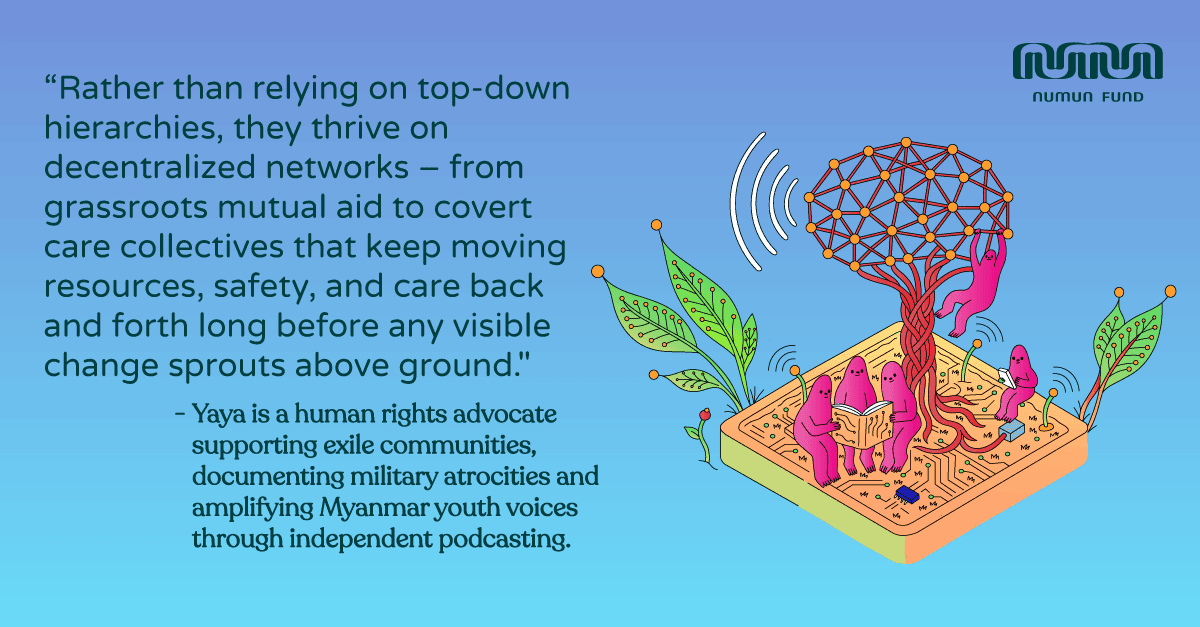
Below the surface, mycelium operates without a single control centre, quietly spreading threads to share nutrients and keep the whole environment resilient. Global feminist movements work similarly. Rather than relying on top-down hierarchies, they thrive on decentralized networks – from grassroots mutual aid to covert care collectives that keep moving resources, safety, and care back and forth long before any visible change sprouts above ground.
This makes participatory grantmaking a natural extension of feminist practice. Traditional philanthropy often acts like a fragile monoculture: top-down, rigid, and quick to exhaust the soil. In contrast, shifting decision-making power directly to local communities honours true intersectionality, and mirrors biodiversity. It recognizes that gender justice is inseparable from racial, Indigenous, queer, and disability justice. An indigenous land defence group in Latin America and a care-work collective in South-East Asia aren’t separate efforts; they are distinct, mutually reinforcing threads of the very same living system.
This approach changes how money flows. Instead of top-down funding decisions made in an office, participatory networks quickly shift resources straight to activists on the ground where needed.
Ultimately, feminist organizing acts like the way fungi absorb toxic waste and compost it back into rich, fertile soil. By breaking down patriarchal and extractive systems, these networks process collective trauma and cultivate transformative justice, proving that real strength was never about individual accumulation, but about taking care of the whole web.
If we view our society through the metaphor of a forest, a dedicated commitment to its revival will allow it to heal and thrive once more, proving that when the ecosystem itself decides where the resources flow, sustainable growth naturally follows.
Yaya is a human rights advocate supporting exile communities, documenting military atrocities and amplifying Myanmar youth voices through independent podcasting.